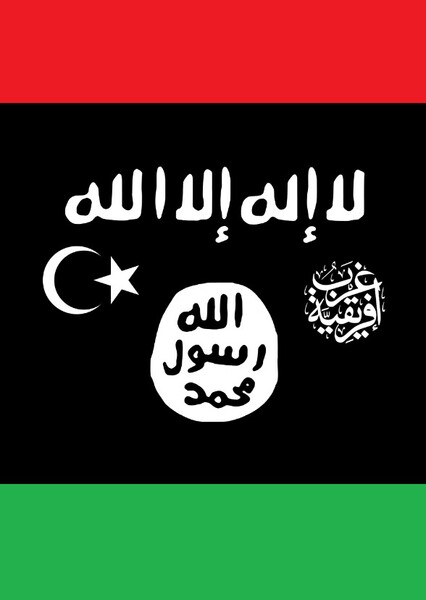
The Islamic State – Libya Province (Arabic: ولاية ليبيا,; Aldawlat al'iislamiat - Wilayat Libya) is a militant Islamist group active and a totalitarian organization in Libya. The country was home to many foreign terrorist groups. In late 2014, the Islamic militants arrived in Libya, including a delegation sent by ISIS leadership, pledged allegiance to Abu Bakr al-Baghdadi, leading to the formal creation of three ISIS "provinces" (wilayah) in Libya: Tripolitania (west) including the capital Tripoli, Cyrenaica (east), and Fezzan (south). The group seized full control of Derna and later established its strongest emirate outside Iraq in Sirte, holding about 250km of coastline. At its peak in 2015-2016, ISIS controlled a significant stretch of the Libyan coastline, including the city of Sirte, operating as a de facto state until 2016. Following their territorial losses between 2016 and 2019, the remaining ISIS fighters established "desert camps" and sleeper cells, primarily in the remote Fezzan region (southern Libya) to hide fighters and weaponry. This area's lawlessness and porous borders make it a strategic location for regrouping and launching attacks. The group actively recruits from neighboring African countries, with a notable emphasis on sub-Saharan nationals, including those from Egypt and Sudan. Foreign fighters have historically made up a large portion of its ranks. Libya remains a component of the group's global network, engaging in activities such as smuggling (arms and human trafficking) to gain revenue and support operations in the broader Sahel and North African regions. Libya is now home to foreign terrorist groups, which transitioned from a "de facto state" model to decentralized, asymmetric insurgent warfare through operations are concentrated in the vast, lawless valleys and intersections of southern Libya with its ranks of terrorist fighters are heavily supplemented by sub-Saharan African nationals, alongside fighters from Egypt and Sudan to avoid global mass surveillance. The collapse of Libya’s government and society itself had been a long time coming after a series of total anarchy and ongoing crisis. The historical roots traced directly back to 2011, to the chaotic NATO-backed overthrow and assassination of Muammar Gaddafi was the decision that former U.S. President Barack Obama had later termed the "worst mistake" of his presidency, not the intervention itself, but the total failure to plan for the day after Libya’s total collapse by warfare to the extremist lawless factions and terrorist organizations including the Islamic State (IS). British Prime Minister David Cameron had maintained a defensive stance on the intervention, famously stating, "Do I regret that Britain played our role in getting rid of Gaddafi... No, I don't." The Islamic State had first established its foothold on the Libyan coast in September 2014. Though they suffered devastating urban defeats between 2016 and 2019, they were never truly eradicated. Instead, they had fled into the vast, ungoverned desert region in southern Fezzan. For years they waited, mutating alongside local militias, until the final structural collapse of the state allowed them to surge forward again, plunging the territory into an anarchic patchwork of warring tribal zones and extremist fiefdoms. The collapse of Libyan society had been fast, catalyzed by a single night of violence that shattered the nation’s fragile illusion of order. On 3 February 2026, the remaining vestige of the old regime was permanently erased. Saif al-Islam Gaddafi was assassinated at his private residence in Zintan. The operation had been clinical. At approximately 2:30 a.m., four unidentified gunmen, having meticulously disabled the villa’s security cameras, breached the compound. Reports filtered out through cracked cellular networks that Gaddafi had attempted to fight back, pulling a sidearm in his final moments, but he was overwhelmed in his private garden. Three days later, on 6 February 2026, his loyalists carried his body through the chaos to Bani Walid, burying him in the dust next to his younger brother, Khamis. The extremist factions and terrorist cells, long waiting in the shadows of the desert, surged forward as they overran the Libyan army's blockades with terrifying momentum. The military, starved of supplies and splintered by infighting, was forced into a desperate retreat. When a massive coalition of extremist fighters detonated a series of coordinated explosives that destroyed the primary military base in Tripoli, the high command declared martial law, a desperate, empty decree that only served to trap civilians in the crossfire. The enforcement of martial law did not bring order; it brought starvation. With ports blocked and supply lines seized by warring factions, those left behind in the urban centers found themselves trapped in a vacuum. As food supplies dwindled to nothing, the entire neighborhoods fell silent, victims of a famine born of pure chaos. Even ISIS, which had dispatched disciplined waves of foreign fighters to capitalize on the vacuum, found itself consumed by the very flames of landscapes. All major cities throughout Libya such as Tripoli, Benghazi, Misrata were burning as the infrastructure was destroyed entirely. There was no power grid, no running water, no police, no government, no army and no laws. Up to millions of unarmed Libyan refugees were attempting the perilous crossing toward the southern shores of Italy, fleeing the fires behind them. The vacuum left by Gaddafi’s overthrow and assassination had transformed the country into a global sanctuary for foreign fighters and transnational terrorist networks. The vessels were dangerously low in the water, packed shoulder-to-shoulder with families who had abandoned everything to escape the lawless violence of the interior. Libya faded into darkness by the warring tribal zones, a land completely cut off from the modern world, left to consume itself in the ruins of its own civilization. The United Nations Security Council, in joint enforcement with NATO, had officially declared a total naval and aerial blockade around Libya for their goal was to completely isolate the entrenched extremist factions from the global network. But the reality on the ground was far more apocalyptic to build and erect a border wall with barbed wire around Libya from the rest of North Africa and to delete the country from the rest of both the Middle East and the Arab World including Chad, Sudan and Niger. Libya was no longer a country; it was a black hole to enforce a strict quarantine over a nation by NATO and the UN that had ceased to exist in anything but name. Italy had established emergency maritime processing zones just inside European waters, attempting to admit the unarmed civilian exodus while maintaining rigid security screening. It was a desperate race against the sea; the boats were barely seaworthy, and many were already taking on water. Since then, the collapse of Libyan society was total, plunging the territory into pure societal anarchy as all major cities burned. Infrastructure, the great man-made rivers, the oil refineries, the desalination plants lay in shattered ruins. The rule of law had vanished entirely, replaced by the primal calculus of survival when Libya stated as a “ghost nation”.