Anime (Japanese: アニメ) is hand-drawn and computer animation originating from Japan. In Japan and in Japanese, anime (a term derived from the English word animation) describes all animated works, regardless of style or origin. However, outside of Japan and in English, anime is colloquial for Japanese animation and refers specifically to animation produced in Japan. Animation produced outside of Japan with a similar style to Japanese animation is referred to as anime-influenced animation. The earliest commercial Japanese animations date to 1917. A characteristic art style emerged in the 1960s with the works of cartoonist Osamu Tezuka and spread in the following decades, developing a large domestic audience. Anime is distributed theatrically, through television broadcasts, directly to home media, and over the Internet. In addition to original works, anime are often adaptations of Japanese comics (manga), light novels, or video games. It is classified into numerous genres targeting various broad and niche audiences. Anime is a diverse medium with distinctive production methods that have adapted in response to emergent technologies. It combines graphic art, characterization, cinematography, and other forms of imaginative and individualistic techniques. Compared to Western animation, anime production generally focuses less on movement, and more on the detail of settings and use of "camera effects", such as panning, zooming, and angle shots. Diverse art styles are used, and character proportions and features can be quite varied, with a common characteristic feature being large and emotive eyes. The anime industry consists of over 430 production companies, including major studios like Studio Ghibli, Sunrise, Bones, Ufotable, MAPPA, CoMix Wave Films, and Toei Animation. Since the 1980s, the medium has also seen international success with the rise of foreign dubbed, subtitled programming and its increasing distribution through streaming services. As of 2016, Japanese anime accounted for 60% of the world's animated television shows. In 2019, the annual overseas exports of Japanese animation exceeded $10 billion for the first time in history.
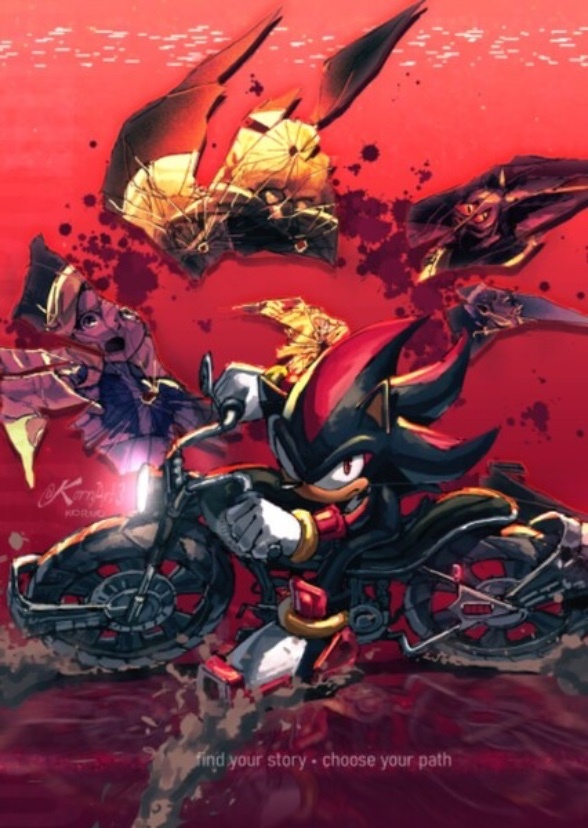
After surviving from the Eclipse Cannon and seeing suffering from amnesia, Shadow the Hedgehog as he sets off to discover and find answers of the truth about his past and find out who - or what - he really is, but his past showed his primary destiny that is not even he knew about. He was already created by Gerald Robotnik, but his DNA comes from the dark lord and leader of the invasive alien race the Black Arms known as Black Doom. Black Doom tells Shadow more about his past than he already knows. So much horrible truths to turn Shadow against his friends and humanity. That's how Shadow is powerful. He was originally going to be the vanguard for Black Doom's invasion. Now Shadow is torn between Maria's wish and his prior destiny chosen by Black Doom. Shadow chooses to continue his hero role, but he'll have to team up with his friends Team Sonic, The Freedom Fighters including Sally Acorn who turned out to be an love interest of Shadow, his partner Rouge, new ally and powerful and intelligent robot named E-123 Omega, The Chaotix, unlikely allies include Eggman Empire and G.U.N. in a three sided war to stop Black Doom and his army of alien invaders, Black Arms from taking control of the planet. Shadow will eliminate his enemies, repay what he did in the previous adventure, and vanquish Black Doom. For he is Shadow the Hedgehog, the black warrior and the protector of Earth who will tear down his enemies one by one.