Age: 51
female
Charlize Theron (/ʃɑːrˈliːz ˈθɛrən/ shar-LEEZ THERR-ən; Afrikaans: [ʃarˈlis ˈtrɔn]; born 7 August 1975) is a South African and American actress and producer. One of the world's highest-paid actresses, she is the recipient of various accolades, including an Academy Award and a Golden Globe Award. In 2016, Time named her one of the 100 most influential people in the world. Theron came to international prominence in the 1990s by playing the leading lady in the Hollywood films The Devil's Advocate (1997), Mighty Joe Young (1998), and The Cider House Rules (1999). She received critical acclaim for her portrayal of serial killer Aileen Wuornos in Monster (2003), for which she won the Silver Bear and Academy Award for Best Actress, becoming the first South African to win an acting Oscar. She received another Academy Award nomination for playing a sexually abused woman seeking justice in the drama North Country (2005). Theron has starred in several commercially successful action films, including The Italian Job (2003), Hancock (2008), Snow White and the Huntsman (2012), Prometheus (2012), Mad Max: Fury Road (2015), The Fate of the Furious (2017), Atomic Blonde (2017), The Old Guard (2020), F9 (2021), and Fast X (2023). She received praise for playing troubled women in Jason Reitman's comedy-dramas Young Adult (2011) and Tully (2018) and for portraying Megyn Kelly in the biographical drama Bombshell (2019), for which she received her third Academy Award nomination. Since the early 2000s, Theron has ventured into film production with her company Denver and Delilah Productions. She has produced numerous films, in many of which she had a starring role, including The Burning Plain (2008), Dark Places (2015), and Long Shot (2019). Theron became an American citizen in 2007, while retaining her South African citizenship. She has been honoured with a motion picture star on the Hollywood Walk of Fame. Description above from the Wikipedia article Charlize Theron, licensed under CC-BY-SA, full list of contributors on Wikipedia.
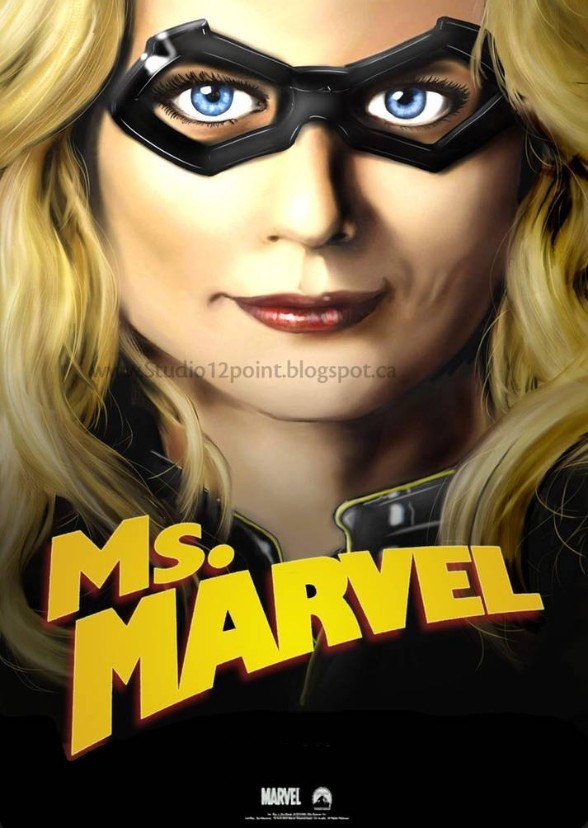
Danvers resurfaces with superhuman abilities and becomes the hero Ms. Marvel (created by writer Gerry Conway and artist John Buscema) in a self-titled series in January 1977, at first written by Gerry Conway and later by Chris Claremont. In the series, she is the editor of Women Magazine, a spin-off of the Daily Bugle. It is revealed that the energy exposure from the explosion of a device called the "Psyche-Magnetron" caused Danvers's genetic structure to meld with Captain Marvel's, effectively turning her into a human-Kree hybrid.[8] Ms. Marvel had a series of semi-regular appearances in The Avengers, with additional appearances with the Defenders,[9] Spider-Man,[10] the Thing,[11] and Iron Man.[12] In one of these stories, the mutant terrorist Mystique kills Michael Barnett, Ms. Marvel's lover.[13] At the time of the publication of Ms. Marvel #1 in 1977, the title was self-consciously socially progressive for its time. This was reflected in the use of the word "Ms.", at the time associated with the feminist movement,[2] and in Danvers fighting for equal pay for equal work in her civilian identity.[14]