Age: 73
male
Daniel Robert Elfman (born May 29, 1953) is an American film composer, singer, songwriter, and musician. He came to prominence as the lead vocalist and primary songwriter for the new wave band Oingo Boingo in the early 1980s. Since scoring his first studio film in 1985, Elfman has garnered international recognition for composing over 100 feature film scores, as well as compositions for television, stage productions, and the concert hall. Elfman has frequently worked with directors Tim Burton, Sam Raimi, and Gus Van Sant, contributing music to nearly 20 Burton projects, including Pee-Wee's Big Adventure, Beetlejuice, Batman, Edward Scissorhands, Batman Returns, Mars Attacks!, Sleepy Hollow, Big Fish, and Alice in Wonderland, as well as scoring Raimi's Darkman, A Simple Plan, Spider-Man, Spider-Man 2, Oz the Great and Powerful, and Doctor Strange in the Multiverse of Madness, and Van Sant's Academy Award-winning films Good Will Hunting and Milk. He wrote music for all of the Men in Black and Fifty Shades of Grey franchise films, the songs and score for Henry Selick's animated musical The Nightmare Before Christmas, and the themes for the popular television series Desperate Housewives and The Simpsons. Among his honours are four Oscar nominations, three Emmy Awards, a Grammy, seven Saturn Awards for Best Music, the 2002 Richard Kirk Award, the 2015 Disney Legend Award, the Max Steiner Film Music Achievement Award in 2017, and the Society of Composers & Lyricists Lifetime Achievement Award in 2022. Description above from the Wikipedia article Danny Elfman, licensed under CC-BY-SA, full list of contributors on Wikipedia.
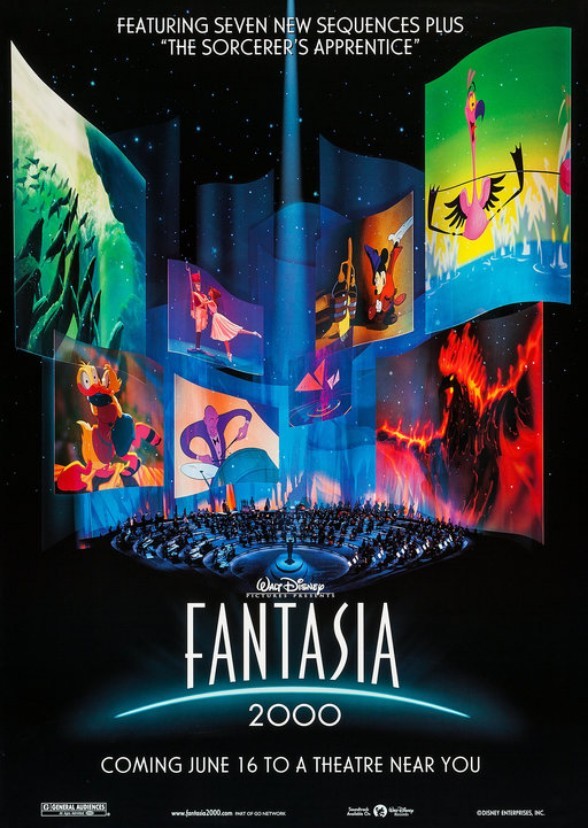
The film begins with the sound of an orchestra tuning and Deems Taylor's introduction from Fantasia. Panels showing various segments from Fantasia fly in outer space and form the set and stage for an orchestra. Musicians take their seats and tune up and animators draw at their desks before James Levine approaches the conductor's podium and signals the beginning of the first piece. Symphony No. 5 (first movement) by Ludwig van Beethoven. Abstract patterns and shapes that resemble butterflies in various colorful shades, tints and hues explore a world of light and darkness whilst being pursued by a swarm of black bats. The world is ultimately conquered by light. Introduced by surviving archival recordings by Deems Taylor. Pines of Rome by Ottorino Respighi. A family of humpback whales are able to fly. The calf is separated from his parents and he becomes trapped in an iceberg. Eventually he finds his way out with his mother's help. The family join a larger pod of whales who fly and frolic through the clouds to emerge into outer space. Introduced by Steve Martin and Itzhak Perlman. Rhapsody in Blue by George Gershwin. Set in New York City in the 1930s, and designed in the style of Al Hirschfeld's known caricatures of the time, the story follows four individuals, Duke, Joe, Rachel, and John, who wish for a better life. The segment ends with all four getting their wish, though their stories interact with each other's without any of them knowing. Introduced by Quincy Jones with pianist Ralph Grierson. Piano Concerto No. 2, Allegro, Opus 102 by Dmitri Shostakovich. Based on the fairy tale "The Steadfast Tin Soldier" by Hans Christian Andersen, a broken toy soldier with one leg falls in love with a toy ballerina and protects her from an evil jack-in-the-box. Unlike the original story, this version has a happy ending. Introduced by Bette Midler featuring pianist Yefim Bronfman. The Carnival of the Animals (Le Carnival des Animaux), Finale by Camille Saint-Saëns. A flock of flamingoes tries to force a slapstick member, who enjoys playing with a yo-yo, to engage in the flock's "dull" routines. Introduced by James Earl Jones with animator Eric Goldberg. The Sorcerer's Apprentice by Paul Dukas. Based on the poem "Der Zauberlehrling" by Goethe, the segment is the only one featured in both Fantasia and Fantasia 2000. It tells the story of Mickey Mouse, an apprentice of sorcerer Yen Sid who attempts some of his master's magic tricks before knowing how to control them. Introduced by Penn & Teller. Pomp and Circumstance – Marches 1, 2, 3 and 4 by Edward Elgar. Based on the story of Noah's Ark from the Book of Genesis, Donald Duck is Noah's assistant and Daisy Duck is Donald's wife. Donald is given the task of gathering the animals to the Ark and misses, loses, and reunites with Daisy in the process. Introduced by James Levine featuring Mickey Mouse and Donald Duck. Firebird Suite—1919 Version by Igor Stravinsky. A Sprite is awoken by her companion, an elk, and accidentally wakes the Firebird, a fiery spirit of destruction in a nearby volcano who destroys the forest and seemingly the Sprite. The Sprite survives and the elk encourages her to restore the forest to its normal state. Introduced by Angela Lansbury.