Age: 65
male
Forest Steven Whitaker (born July 15, 1961) is an American actor, producer, director, and activist. He is the recipient of various accolades, including an Academy Award, a Golden Globe Award, a British Academy Film Award, and two Screen Actors Guild Awards. After making his film debut in Fast Times at Ridgemont High (1982), Whitaker went on to earn a reputation for intensive character study work for films, such as Platoon (1986), Good Morning, Vietnam (1987), Bird (1988), The Crying Game (1992), Phenomenon (1996), Ghost Dog: The Way of the Samurai (1999), The Great Debaters (2007), The Butler (2013), Arrival (2016), and Respect (2021). He has also appeared in blockbusters, such as Panic Room (2002), Rogue One: A Star Wars Story (2016) as Saw Gerrera, and Black Panther (2018) as Zuri. For his portrayal of Ugandan dictator Idi Amin in the British historical drama film The Last King of Scotland (2006), Whitaker won the Academy Award for Best Actor. Whitaker made his directorial debut with the television film Strapped (1993), and directed the films Waiting to Exhale (1995), Hope Floats (1998), and First Daughter (2004). Apart from his film career, Whitaker is also known for his humanitarian work and activism. In 2011, he was inducted as a UNESCO Goodwill Ambassador, later receiving a promotion to Special Envoy for Peace and Reconciliation, and serves as the CEO of Whitaker Peace and Development Initiative (WPDI), a non-profit outreach program.
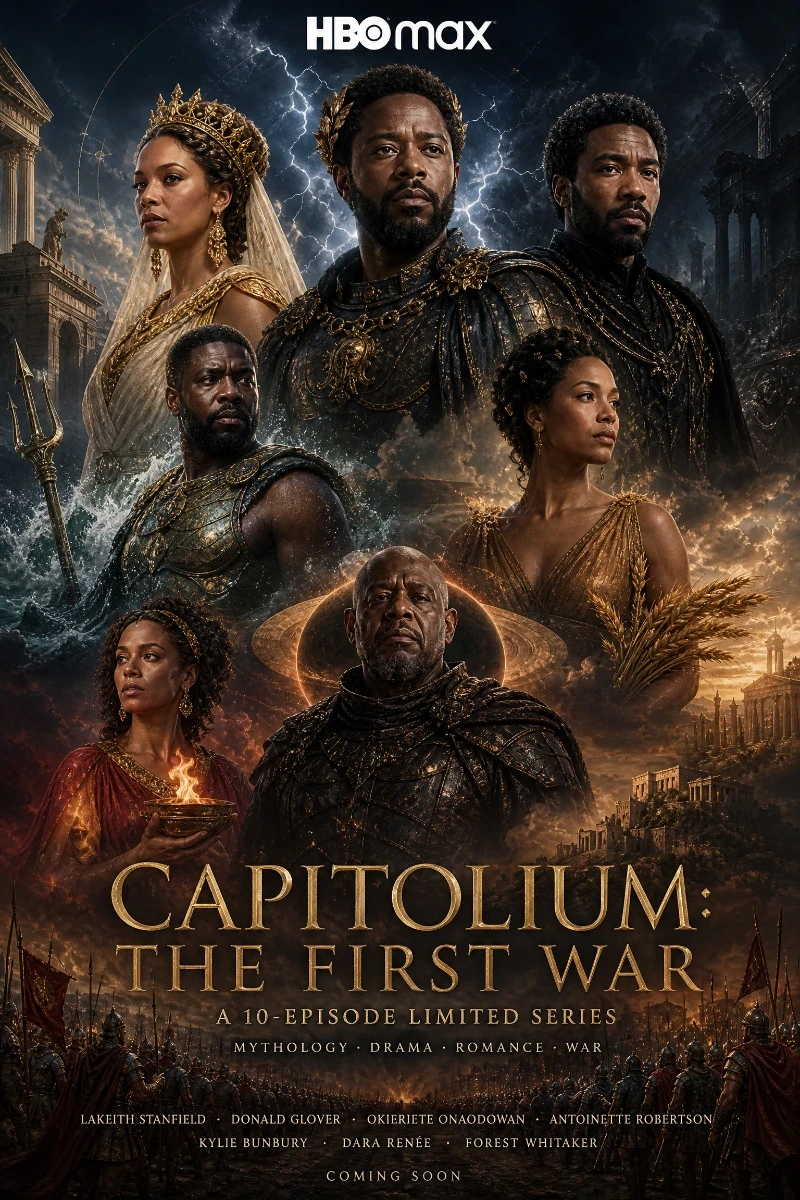
Before Rome had a city, it had gods. Before the gods had order, they had the war against the Titans. This is what it cost them. The Roman Chronicles opens with its most epic, most visually ambitious installment: the war between the Olympian gods (in their Roman identities) and the Titans who preceded them. Jupiter, Neptune, Pluto, Juno, Ceres, and Vesta fight together as siblings against the Titanic forces of Saturn who swallowed them. The series is deliberately Roman rather than Greek in its register — the gods are portrayed with the specific Roman character: more formal, more civic, more concerned with the ordering principles of the cosmos than with individual passion. Jupiter is not merely ambitious — he wants a cosmos governed by law. Neptune is not merely volatile — he is the sea's necessity made divine. Pluto is not a reluctant inheritor — he is a god whose domain is the most necessary of all three, who accepts it with the calm of someone who understands that without death, life has no meaning. The Titanomachy here is a war of governance, not of revenge. S1E1 — The Drawing of Lots After the Titanomachy's conclusion, the three brothers draw lots for dominion. The sequence is treated as the universe's founding civic act — Pluto receives the Underworld with the dignity of a god who understands that governance, not glamour, is the highest calling. S1E5 — Saturn's Court A flashback to the Titan court — the gods as children within their father's palace, before the war. Pluto as a young divine, already the most patient and most observant of the siblings. S1E10 — Pax Deorum Series finale: The new divine order established. Each god taking their domain. Pluto's final scene — descending into the Underworld not as exile but as sovereign, arranging it with the same careful attention to order that will characterize his governance for eternity.